TL;DR
Low-cost index funds give ordinary investors a simple way to own broad groups of companies without trying to select market winners. Their main advantages are diversification, low ongoing fees and a strategy that is easy to repeat for decades. Consistent monthly investing does not guarantee profits, but over long periods it can turn modest contributions into a meaningful part of your net worth.
Why Index Funds Play Such a Powerful Role in Wealth Building
Building net worth through investing does not require guessing which company will dominate the next decade. It does not require watching the market every day or paying a manager to make frequent trading decisions.
An index fund follows a defined market index. An S&P 500 index fund, for example, aims to track the performance of large publicly traded U.S. companies represented in that index. A total-market index fund spreads ownership across a broader range of U.S. stocks. International index funds add companies outside the United States.
The approach is simple: own a diversified group of businesses at low cost and continue investing through good markets and difficult ones.
The long-term active-versus-index evidence is strong, but it should be stated accurately. The SPIVA U.S. Year-End 2025 Scorecard from S&P Dow Jones Indices reports that 92.89% of active large-cap U.S. equity funds underperformed the S&P 500 over the 20-year period ending December 31, 2025, based on absolute return.
That does not mean an index fund will outperform every active fund in every future period. It does show how difficult it has been for most active large-cap funds to beat a broad benchmark over long stretches of time, especially after costs are included.
For someone trying to grow net worth steadily, simplicity can be an advantage. The less time spent chasing recent winners or switching strategies, the more time money has to remain invested and compound.
The Compound Growth Mechanics
Investment growth becomes powerful because returns can build on earlier returns. When an investment grows, future gains are applied to both your contributions and any past growth that remains invested.
This is why time matters so much. Contributing consistently in your 20s can produce a larger long-term result than contributing more aggressively after waiting ten years to begin.
The Rule of 72
The Rule of 72 is a quick mental estimate for how long money may take to double at a fixed annual return. Divide 72 by the assumed annual return:
72 ÷ Annual Return = Approximate Years to Double
At a hypothetical 7% annual return, money doubles in roughly 10.3 years. At 10%, it doubles in approximately 7.2 years.
This is only an estimate, and investments do not earn fixed returns year after year. A stock index can fall sharply in one year and rise in another. Still, the rule helps explain why leaving invested money untouched for decades can matter more than trying to make perfect short-term decisions.
An investor who begins early gives every contribution more potential doubling periods. That advantage is difficult to recreate later, even with larger deposits.
The Real Power of Low Expense Ratios
Investment performance receives attention, but fees quietly affect what remains in your account.
An expense ratio is the annual operating cost charged by a fund, expressed as a percentage of invested assets. A fund charging 0.03% costs approximately $3 per year for each $10,000 invested. A fund charging 1.00% costs approximately $100 per year for the same balance.
The gap may appear small in one year. Across decades, the lost growth on those fees becomes substantial.
Consider a hypothetical $500,000 investment held for 20 years. Assume both funds earn the same 7% annual gross return before expenses, with no additional contributions and no taxes considered.
| Annual Expense Ratio | Approximate Value After 20 Years |
| 0.03% | $1,924,021 |
| 1.00% | $1,603,568 |
| Difference | $320,453 |
The lower-cost investment finishes with more than $320,000 in additional value under these assumptions, even though both started with the same money and earned the same gross return before fees.
This is why cost matters. You cannot control what the market returns next year. You can control how much of your return is surrendered to ongoing fund expenses.
As of 2026, examples of low-cost index products include Vanguard’s S&P 500 ETF, VOO, with a 0.03% expense ratio; Vanguard 500 Index Fund Admiral Shares, VFIAX, with a 0.04% expense ratio; and Fidelity 500 Index Fund, FXAIX, with a 0.015% expense ratio. Costs can change, so investors should always confirm current fund disclosures before investing.
Dollar-Cost Averaging: A Repeatable Investing Habit
Dollar-cost averaging means investing the same dollar amount at regular intervals, regardless of market movements. Someone contributing $300 every month to an index fund is following this approach.
When share prices fall, the fixed monthly amount buys more shares. When prices rise, it buys fewer. This creates a consistent system and reduces the temptation to delay investing while waiting for the “right” market moment.
According to Investor.gov, dollar-cost averaging can help investors manage risk through a regular pattern of investing over time. It does not eliminate investment risk. Your account can still decline, and regularly investing a lump sum that is already available may not always produce a higher return than investing it immediately.
Its greatest practical advantage is behavioral: money goes into the market on schedule instead of relying on repeated guesses about what prices will do next.
For employees investing through each paycheck in a workplace retirement account, this pattern may already be happening automatically.
Net Worth Impact at Different Starting Points
Suppose two investors each contribute $300 per month and earn a hypothetical 7% annual return, compounded monthly. The only difference is when they begin.
The first investor starts at age 25:
| Age | Years Invested | Total Contributed | Projected Value |
| 35 | 10 years | $36,000 | $51,925 |
| 45 | 20 years | $72,000 | $156,278 |
| 65 | 40 years | $144,000 | $787,444 |
The second investor waits until age 35:
| Age | Years Invested | Total Contributed | Projected Value |
| 45 | 10 years | $36,000 | $51,925 |
| 55 | 20 years | $72,000 | $156,278 |
| 65 | 30 years | $108,000 | $365,991 |
By age 65, the investor who started at 25 has contributed only $36,000 more than the person who waited until 35. Yet the projected account value is approximately $421,453 higher.
That difference comes from time. The earliest contributions had an additional decade to remain invested and potentially grow.
These projections are illustrations, not guaranteed outcomes. Actual returns will vary, and a stock-focused index fund can lose money during market declines. Still, the example shows why beginning with a manageable contribution can matter more than waiting until you feel able to invest a larger amount.
Which Index Funds Might Fit a Long-Term Portfolio?
An index fund is not automatically suitable simply because it is low cost. Investors still need to consider diversification, risk tolerance, account type, time horizon and the role each holding plays in the portfolio.
Common categories investors research include:
- U.S. total market funds, such as VTI or FSKAX, which provide exposure to a broad range of U.S. publicly traded companies.
- S&P 500 funds, such as VOO, VFIAX or FXAIX, which focus on large U.S. companies represented in the S&P 500.
- International stock funds, such as VXUS or FZILX, which provide exposure to companies outside the United States.
An S&P 500 fund alone does not represent every type of investment risk or every region of the world. Someone approaching retirement may also need to consider cash reserves and fixed-income holdings rather than relying entirely on stocks.
This article is educational, not individualized investment advice. Before choosing investments, review the fund prospectus, current expenses, account tax treatment and your ability to accept market losses. A fee-only financial adviser can help with personal planning when your situation is complex.
Tracking Your Investment Net Worth
An investment account balance is valuable, but it becomes more meaningful when seen alongside your complete financial picture.
A growing brokerage account can increase net worth. So can retirement savings. But high-interest credit card balances, student loans, auto financing or a large mortgage can reduce the total at the same time.
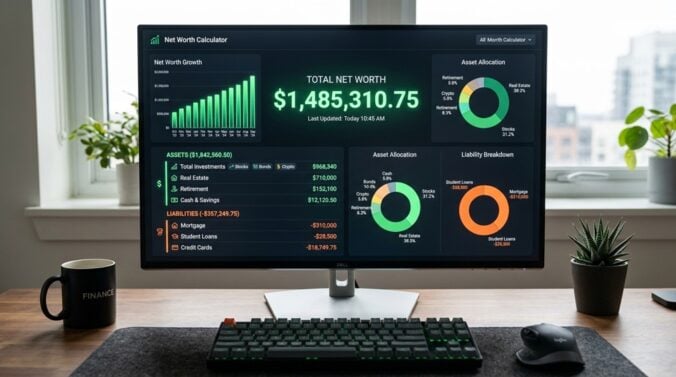
Add your brokerage, 401(k), IRA and other investment balances to a net worth calculator alongside your cash, property values and debts. Updating the figures monthly or quarterly helps you see if regular investing is increasing your overall financial position rather than viewing one account in isolation.
Do not become discouraged by short-term declines. A monthly update during a market drop may show net worth temporarily moving lower even while your investing habit remains sound for a long-term goal. Focus on contributions made, costs kept low, debt managed and the trend over several years.
Additional practical resources on measuring assets, liabilities and personal financial progress are available through NetlyWorth.
Simple Does Not Mean Risk-Free, but It Can Be Effective
Low-cost index investing is not a shortcut to guaranteed wealth. Markets fall, returns are uncertain and no fund replaces a financial plan built around your goals and risk tolerance.
What index funds offer is a practical system: broad exposure, low costs and an approach that can be repeated through decades of earning and saving. Choose investments carefully, contribute consistently and track how your assets fit into your total net worth. Wealth is rarely built by one perfect trade. It is more often built by keeping a sensible plan in motion for long enough to matter.