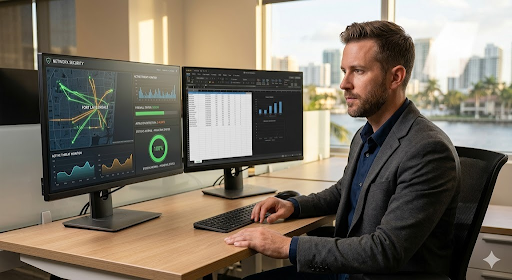
Fort Lauderdale is growing fast. Broward County’s economy continues to expand across financial services, healthcare, legal, real estate, and professional services. With that growth comes increased reliance on technology and with increased reliance on technology comes a bigger target on the back of every business that has not built its IT and security infrastructure to match.
The cybersecurity threat landscape facing Fort Lauderdale businesses today is active and increasingly automated. Attacks that once required significant technical effort can now be launched at scale using AI-assisted tools. Business email compromise, ransomware, credential theft, and supply chain attacks are no longer problems only for large enterprises. Small and midsize businesses in South Florida are actively targeted, often precisely because their defenses are weaker than those of larger organizations.
The businesses staying ahead of this environment are not the ones spending the most on technology. They are the ones taking a proactive approach monitoring continuously, addressing vulnerabilities before they become incidents, and working with IT partners who understand both the technology and the specific demands of the South Florida market. Mindcore Technologies serves businesses in Fort Lauderdale with managed IT, cybersecurity, cloud services, and AI-powered automation that make proactive security and operations management accessible for organizations of all sizes.
Why Reactive IT Is No Longer Enough
Most businesses start with reactive IT. Something breaks, someone calls for help, the problem gets fixed. For years, this approach was adequate. Technology environments were simpler, threats were less frequent, and the cost of downtime was manageable.
That equation has changed significantly.
Today’s business technology spans cloud platforms, remote endpoints, mobile devices, SaaS applications, and third-party integrations. When something in that environment fails or is compromised, the chain reaction can affect payroll, customer communications, compliance reporting, and sales operations simultaneously.
Reactive IT means discovering problems after they have already begun causing damage. Proactive IT means detecting anomalies, closing vulnerabilities, and maintaining systems before any of that damage occurs. The difference in operational outcome between these two approaches has never been more significant than it is right now.
The Cost of Waiting
Consider what happens when a Fort Lauderdale business experiences a ransomware attack without a tested recovery plan in place:
- Systems are encrypted and inaccessible, halting operations across the organization
- Recovery without clean backups can take days or weeks
- Regulatory notification requirements add compliance exposure on top of operational disruption
- Revenue loss and reputational damage accumulate throughout the recovery period
- Post-incident security remediation costs often exceed the original ransom demand
Now consider the same scenario with proactive infrastructure in place: monitored backups that are tested regularly, endpoint controls that limit the spread of an infection, and a documented incident response plan that guides a measured, organized recovery. The difference is not in whether an attack occurs. It is in what happens next.
The Cybersecurity Priorities Fort Lauderdale Businesses Are Acting On
Across South Florida’s business community, a clear set of security priorities has emerged among organizations that are moving from reactive to proactive postures.
Multi-Factor Authentication Across All Accounts
Credential theft through phishing remains one of the most common initial access vectors for attacks affecting Fort Lauderdale businesses. Multi-factor authentication is the single most effective control for limiting what an attacker can do with a stolen password. Despite this, many businesses still have not deployed it consistently across every account, cloud applications, email, VPN access, and internal systems included.
Continuous Endpoint Monitoring
Every device accessing business systems is a potential entry point. As workforces have become more distributed, the number of devices that need to be managed, maintained, and monitored has grown considerably. Continuous endpoint monitoring ensures that devices accessing the network meet security standards and that anomalies are detected in real time rather than during a post-incident review.
Tested Backup and Recovery Infrastructure
Backups that exist but have never been tested are not reliable recovery infrastructure they are untested assumptions. Fort Lauderdale businesses with genuinely resilient disaster recovery have documented recovery procedures, defined recovery time objectives, and regularly scheduled backup tests that confirm data can actually be restored within an acceptable window.
AI-Assisted Threat Detection
AI-powered security tools analyze network behavior, log data, and endpoint activity against known attack patterns and behavioral baselines. They surface genuine threats faster than manual review can, reduce false positive alert fatigue for IT teams, and enable faster containment when an incident does begin. For Fort Lauderdale businesses without large internal security teams, AI-assisted monitoring dramatically extends the reach of available IT resources.
Matt Rosenthal, President and CEO of Mindcore Technologies, has spent more than 30 years building IT and security infrastructure for businesses across Florida. His view on what separates resilient organizations from vulnerable ones is consistent: “The businesses that weather security incidents with the least disruption are the ones that made the foundational investments before anything went wrong. Tested backups. MFA everywhere. Continuous monitoring. These are not exciting controls, but they are the ones that actually determine outcomes.”
What to Look for in a Fort Lauderdale IT Partner
Not every IT provider delivers the same level of service, and the gaps become most visible at the worst possible moments. For Fort Lauderdale businesses evaluating their options, several criteria consistently distinguish IT partners that deliver lasting value.
Local presence enables on-site response when situations require it. For critical system failures and security incidents, remote-only support creates delays that a local team eliminates.
Sector-specific experience ensures that compliance obligations in healthcare, financial services, legal, and insurance are understood and built into standard operating practice, not treated as an afterthought.
Proactive communication keeps business leadership informed about the state of the technology environment, upcoming risks, and infrastructure decisions, before problems force the conversation.
Client retention is the most reliable signal of sustained value delivery. Providers with long-term client relationships are doing something right that short-tenure providers are not.
Conclusion
Fort Lauderdale businesses that invest in proactive IT and cybersecurity infrastructure are building compounding advantages: fewer disruptions, stronger compliance posture, faster recovery when incidents do occur, and the operational confidence that comes from knowing the technology environment is being managed rather than simply tolerated.
The threats are real. The investment required to address them is accessible. The question is whether that investment happens deliberately or gets forced by an incident that costs far more to resolve than it would have cost to prevent.
Thank you for reading!
About the Author
Matt Rosenthal is the President and CEO of Mindcore Technologies, an AI-powered IT and cybersecurity services firm with offices in Fort Lauderdale and Boca Raton, Florida, as well as New Jersey, Maryland, and South Carolina. With more than 30 years of experience at the intersection of business and technology, Matt has led IT and cybersecurity initiatives for organizations across Florida navigating complex infrastructure, security, and compliance environments.